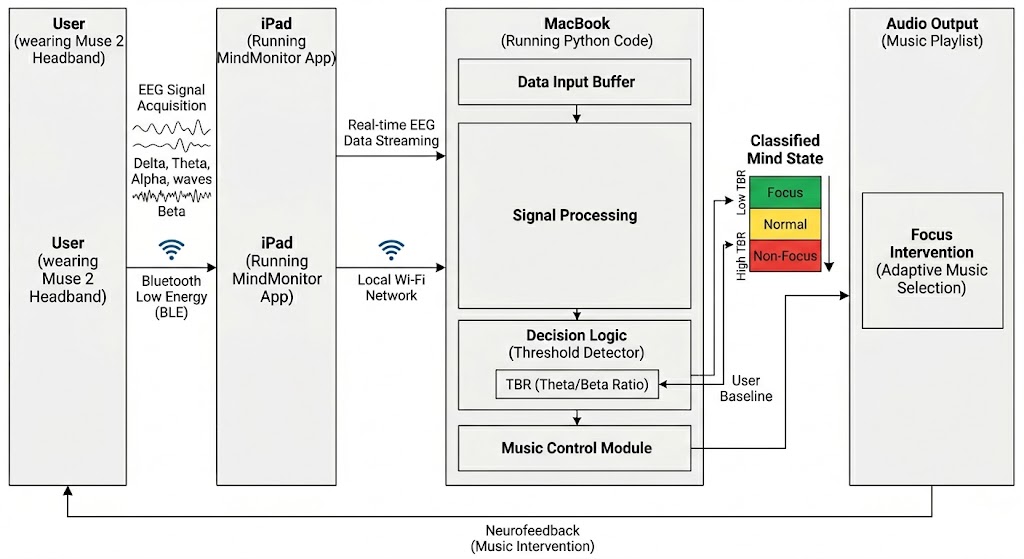
System architecture
Adaptive Music BCI — full signal path
Over the course of a year, I ran a series of experiments measuring how different genres — pop, jazz, classical and computer-generated tracks — affect brainwave activity, recorded through an EEG (electroencephalogram) system. Each participant’s brain activity was recorded for two minutes as a resting baseline, before they were played a standardised recording containing the different genres, using a Muse 2 headband throughout. Because particular frequency bands correlate with particular moods and frames of mind, the recordings offer a way of asking whether a genre does something measurable rather than merely something felt.
The data suggested that jazz and computer-generated soundtracks were the most capable of shifting brain state. Jazz and pop produced a significant reduction in alpha activity — the band that dominates when the mind is unfocused or daydreaming — while jazz and alpha-frequency tracks significantly lowered gamma activity. Those findings became the basis for the two playlists below, and for the closed-loop system further down this page.
Each band corresponds to a different state of arousal. Alpha rises when attention drifts; gamma is associated with heightened cognitive load.
I was invited onto the Sevenoaks School Music Podcast — a series made for the school community — to discuss the project and what the EEG data showed.
Episode 9 · 34 minutes
A written account is also due to appear in Innovate, the school’s journal for teaching and learning.
The Muse 2 is a consumer device with only a handful of electrodes, so its resolution falls well below research-grade EEG and it is vulnerable to movement artefacts. Recording also took place in an observed, controlled setting, which is not how anyone ordinarily listens to music.
The design rests on inductive reasoning too: one piece of jazz cannot stand for all jazz, and tempo, key or familiarity could be doing the real work. A change observed while a track played does not establish that the track caused it — the findings are a reason to look further, not a settled result.
Two playlists built directly from the EEG results — each track selected because the data supported the brain-state shift it was meant to produce. They are now played in the school’s wellbeing room, where students go to decompress between lessons.
For when your mind has wandered too far. Jazz and pop are shown to reduce alpha brainwaves — the waves dominant when you’re unfocused and daydreaming. EEG-backed tracks to help you return to the present.
Calm, backed by science. EEG analysis found that jazz and alpha-frequency tracks significantly reduce gamma wave activity, helping the mind slow down. For when you want to unwind.
Three weeks · Diagnosis of psychiatric disorders
A placement in the Computer Science laboratory at Hong Kong Baptist University, on a data science project applying machine learning to fNIRS (functional near-infrared spectroscopy) recordings with the aim of supporting the diagnosis of psychiatric disorders.
Working alongside computer scientists, my contribution was to bring the biological perspective to the algorithm — questioning whether the features the model was learning from made physiological sense — and to help troubleshoot when its behaviour diverged from what the underlying neuroscience would predict.
Three days · Drosophila behaviour
Three days shadowing in the lab where I went on to run the investigation for my IB Extended Essay. I had already designed and carried out my own trials beforehand, but seeing the same kind of question handled at research level — the precision of the protocols, the care taken over conditions I had treated as incidental — gave me a clearer sense of what my own results could and could not show, and changed how I ran the rest of the experiment.
How does caffeine affect long-term olfactory memory in fruit flies?
Two days · Adapted patient care
Two days observing a clinic treating patients with cognitive and developmental differences, where routine dentistry is adapted in pace, communication and environment for people it would otherwise be inaccessible to.
The clinical procedure itself differed too: anaesthesiology was used not only for surgery but for ordinary treatment, allowing care to be delivered safely to patients who could not otherwise tolerate it. Seeing that made clear how much of medicine is the work of adapting a treatment to the person in front of you, rather than the treatment alone.
A closed-loop system that reads brain activity in real time from a Muse 2 headband, detects when attention drops, and fades in focus-recovery music until concentration returns. Attention is quantified using the Theta/Beta Ratio (TBR) — slow-wave power divided by fast-wave power — which rises as concentration lapses. The loop runs continuously: the music responds to the brain, and the brain responds to the music. I built it in Python with the help of AI coding tools, which let me work at a level of implementation I could not yet have reached alone — the design decisions, the thresholds and the neuroscience behind them are my own.
View on GitHubSelect a stage to see what happens inside it.
The system computes the Theta/Beta Ratio — slow-wave power divided by fast-wave power. A low ratio indicates sustained focus; a high one indicates drifting attention. Drag the slider, or let it run on simulated data.